Lehigh County Courthouse
The Good Nurse: A True Story of Medicine, Madness, and MurderThe Lehigh County Courthouse in Allentown, Pennsylvania, is the setting for a March 20, 2006, sentencing proceeding that turns into a confrontation between Charles Cullen and the court. Its route through a stalled renovation project leads the victims’ families from stripped, unfinished rooms into a bright, ornate courtroom. There, Cullen demands that Judge William Platt recuse himself, disrupts the proceedings, and is ultimately removed as three more concurrent life sentences are announced. The courthouse gives the scene both its physical contrasts and its stark public stakes: a formal place of judgment becomes the stage for an episode that leaves the families shaken and unsatisfied.
Setting and Approach
The courthouse stands in downtown Allentown, a city described as a poor steel town amid the ruins of a richer one. Its ceremonial public spaces, built from imported stone and marked by soaring colonnades, sit beside visible urban hardship. Against that backdrop, families arrive in dark formal clothing, wearing small blue stickers from OfficeMax on their lapels to identify themselves as victims of the Angel of Death. Their small, practical markers make a public identity out of private loss, and establish the people who have come to court not merely as spectators but as those directly affected by Cullen’s crimes.
The building itself is still caught between past grandeur and unfinished change. Much of the old courthouse has been gutted as part of a stalled renovation. Family members are led through rooms stripped to their lathing, past rooms crowded with chrome-green filing cabinets, and along stairs and flickering halls. The route resembles a guided tour through a building whose ordinary functions have been interrupted: the families must pass through disrepair before reaching the room where the legal consequences of Cullen’s actions will be pronounced.
The Courtroom
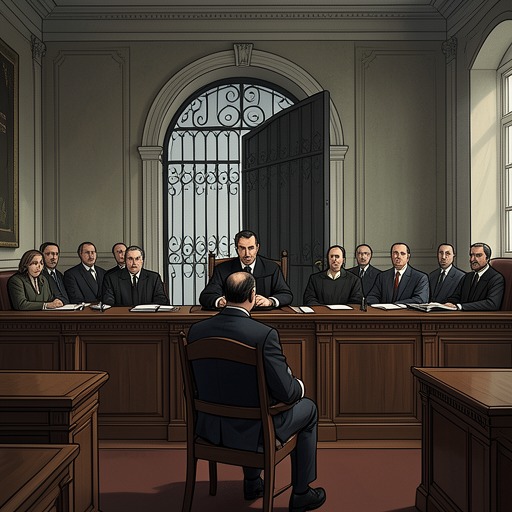
At the end of the dim passage is a surprisingly bright nineteenth-century Italianate courtroom. Its gilt surfaces, Beaux-Arts ornament, marble, and forty-foot ceiling create an image of civic authority and display. Concentric filigree rings and a Medusa chandelier rise above Judge Platt’s place; a giant desk, Federalist-style lamps, and intricate railings separate the judge from the courtroom below. The room’s splendor is sharply unlike the gutted spaces through which the families have just been led. The contrast makes the courtroom feel at once magnificent and set apart from the unfinished building around it.
Cullen appears in restraints that make him look, for perhaps the first time, like the stereotypical serial killer. His hands are chained in front of him, and institutional leather manacles hold his legs in place. The effect is imposing, though the narrative stresses that he is not physically dangerous in this courtroom context. The restraints turn the expected image of a dangerous prisoner into a visible performance of custody, while the ornate room supplies a setting of public judgment. The account observes that the county might have bound him even more conspicuously if it could; the proceeding will soon make that imagined spectacle real in another form.
Cullen’s Challenge to the Court
The scene carries an added tension because Cullen’s proposed kidney donation remains unresolved. After earlier conversations about his sensitivity to other people’s suffering, the account considers the expectation that he might behave carefully before the families, especially while the donation’s prospects remain exposed to public opinion. Instead, he uses his opportunity in court to intensify the families’ distress. He recites from memory statements Judge Platt has made to the press and then demands that the judge step down. Platt denies the motion to recuse.
The exchange does not settle into a quiet sentencing. Cullen continues to chant through the proceeding, while the court announces three additional life sentences to be served concurrently with those already imposed. The final statement that he will remain in prison for the rest of his natural life closes the formal sentencing, but not the disturbance: court officers frog-march him out, bound, gagged, and duct-taped. He is still chanting as the elevator doors close. The sudden silence afterward becomes part of the scene’s ending, a pause following a spectacle that the families have had to witness in the very room where judgment was delivered.
Families and the Courthouse’s Public Meaning
Afterward, the families gather in the hallway, shaken and unsatisfied. Julie Sanders, whose friend Cullen overdosed, says she believes he meant to disrespect everyone in the courtroom. She sets his conduct against his professed compassion and his wish to donate a kidney to save a life, asking where that compassion was during the hearing. Her response gives the courthouse scene a second measure of consequence: the sentence establishes the legal outcome, but it does not answer the families’ questions about whether Cullen understands what he has done to their lives.
The location therefore holds two forms of public reckoning in tension. The courtroom’s marble, gilt, and judicial barriers lend the proceedings ceremony; the gutted corridors and flickering halls expose a building still in disrepair. Within that setting, legal finality—three more concurrent life sentences and a declaration of imprisonment for life—coexists with unresolved grief. The courthouse can pronounce a sentence, but the scene ends with the families still gathered in the hallway, left with the impact of Cullen’s disruption and the absence of the recognition they sought.